CASA Advisory Circular
It is encouraging that CASA have published a recent advisory circular on managing smoke and fumes including bleed air contamination and that cabin air event management and reporting can be improved.
AC 91-34 v1.0 - Management of smoke and fume events
Cabin Air Event Checklist development
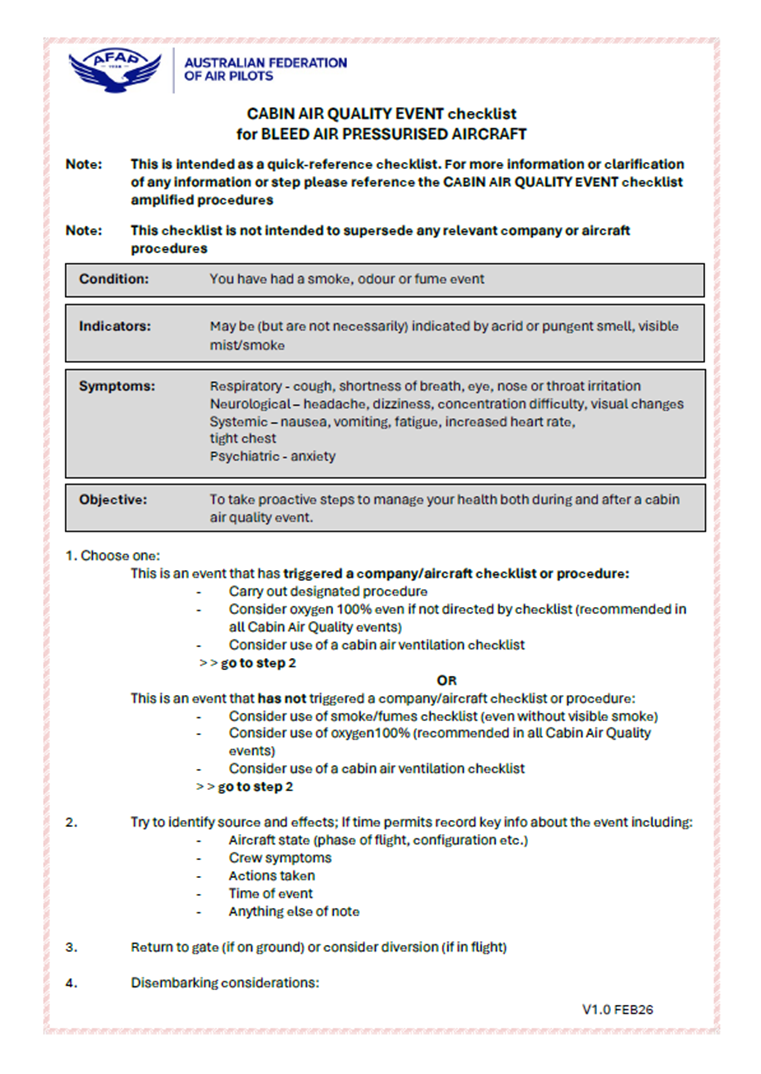
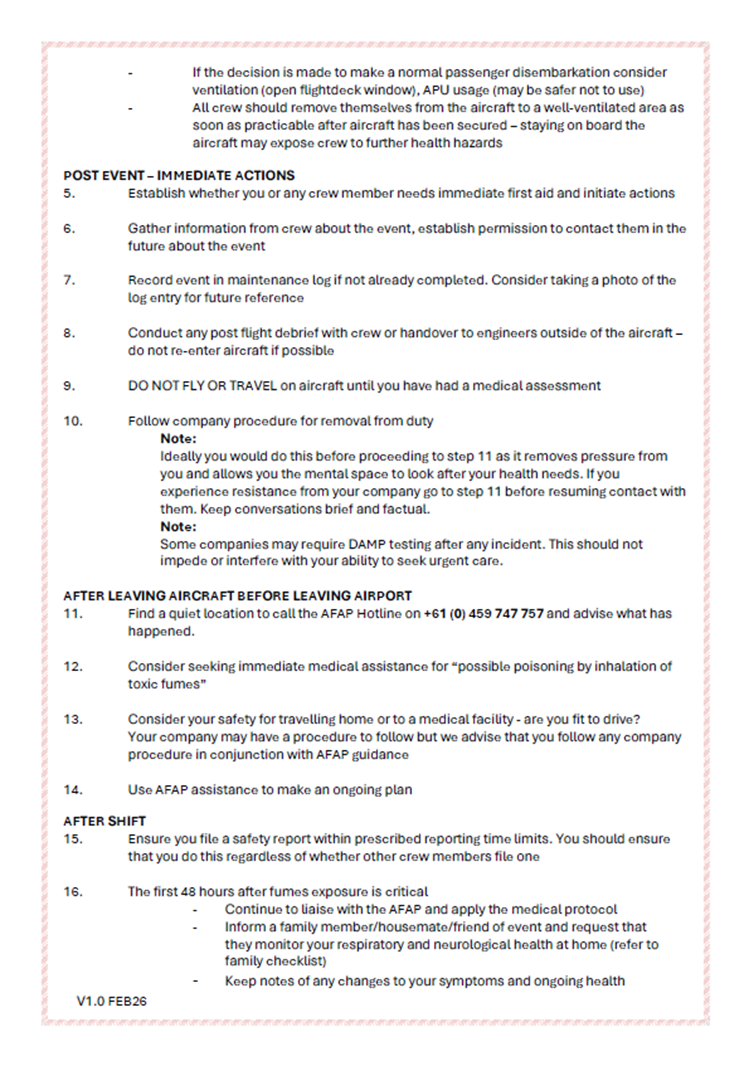
The AFAP has been developing a Cabin Air event checklist for members to assist in taking important steps if they have a cabin air event. The concept is for member pilots to carry the checklist in their flight bag. AFAP staff have also had training to support a member to ensure the important first steps are taken to protect their own health. The checklist will be distributed to members. See Appendix 1 below.
Cabin Air Quality (Aero-toxicity)
Summary of latest GCAQE newsletter - January 2026
- GCAQE Board and subject matter experts
- All Party Parliamentary Group on Cabin Air Quality: The GCAQE board has approved an important initiative to bring the cabin air quality issue into greater focus with policy makers and politicians. In the United Kingdom elected politicians (members of parliament or Lords) can form an All Party Parliamentary Group (APPG) to look or investigate a particular issue. An APPG is being set up to look at cabin air quality and it will hold hearings on the 10th and the 11th of March 2026 in London.
- In memory of Dr Jonathan Burdon: Dr Burdon sadly passed away on 19 November 2025. Dr Burdon, was a past Chairman of The Thoracic Society of Australia and New Zealand and the National Asthma Council Australia and was Director of Respiratory Medicine at St Vincent’s Hospital, Melbourne from 1990-2000. He had met numerous airline crews from around the world suffering from respiratory problems as a consequence of exposure to contaminated bleed air. He was a remarkable man who did so much to help raise awareness of the cabin air quality issue and worked very closely with Susan. He was one of the key authors on the medical protocol paper which Susan and a dozen others worked on for many many years. That is the paper which has become the established medical protocol for how to deal with crews after an event and is on our website. He has spoken numerous times at conferences and Susan put him forward for the Order of Australia, which he received some years over and was very proud to get. He will be truly missed. He was a huge voice on this issue having seen crews suffer first hand.
- EASA Research: The EASA findings presented to attendees in Cologne implied that mice inhaling heated oil fumes had no problems. Judith Anderson provided the GCAQE position which highlight a flawed research project which even many industry attendees commented was flawed. The oil was not heated to the temperatures present at the high pressure bleed off take, failed to look at the endocrine effect, the mixture with hydraulic fluids and did not replicate the exposure scenarios found in aircraft accurately.
- GCAQE Membership numbers
- 2026 GCAQE annual meeting and 2026 Aircraft Cabin Air Conference: The 2026 GCAQE AGM will take place in London at Imperial College.
- 2026 Charity walk for Susan
- Update on NYCO 940SE oil
- New EASTMAN oil
- Other research: the blood test developed by Professor Furlong used a biomarker of exposure which was linked to an ingredient in engine oils when the blood test was first developed in the mid 2000s. This byproduct in the oil was removed in the 2010s era, consequently, the blood test failed to be an accurate marker of exposure in current day exposures. To address this short fall, a different branch of the University of Washington is now carrying out research over the next 10 months to look at a brand-new biomarker of exposure. Anybody who previously supplied blood please note the blood is being kept frozen until a new biomarkers identified.
- FAA: The US FAA issued this update on Cabin Air Quality on Thursday, September 4, 2025 and is worth being aware of: https://www.faa.gov/newsroom/cabin-air-quality-0
AFAP/Resilient Pilot (RP) Program
AFAP Resilient Pilot program info available on AFAP website. Click below to review. Or scan the QR code.
AFAP Resilient Pilot program

The Resilient Pilot program continues to expand across the industry, engaging pilots from major airlines, general aviation, and emergency services. AFAP CBTi’s are actively delivering competency development scenario (CDS) sessions, with consistently positive feedback from members. There is growing interest from operators in developing Resilient Pilot trained instructors, alongside emerging opportunities to adapt the program as a Human Factors tool, including within helicopter operations. Additionally, AFAP has involvement in observing and participating in instructor training overseas to introduce APAC regional instructor development capability.
Training and Skills Development - Industry Skills Australia (ISA)
Recent AFAP submission to the Evaluation of the National Industry Engagement Arrangements (NIEA)
The AFAP’s February 2026 submission to the Evaluation of the National Industry Engagement Arrangements (NIEA), through Industry Skills Australia (ISA) – Aviation, strongly supports the NIEA as a significant and positive reform, particularly endorsing its formal tripartite structure bringing together employers, unions and government. AFAP emphasised that, for the first time in many years, workforce representatives are structurally embedded in aviation skills and workforce planning discussions, addressing past employer dominant consultation models and better aligning training design with operational safety realities.
From an aviation perspective, AFAP reports improved stakeholder diversity within workforce planning committees, more substantive union input into competency and instructor training discussions, and a broader strategic remit beyond narrow training package updates. While acknowledging challenges such as time intensive processes, competing sector interests and occasional corporate dominance in discussions, AFAP considers these reflective of sector complexity rather than design flaws.
AFAP recommends refinement rather than structural redesign, including clearer process transparency, streamlined consultation timelines, strengthened workforce voice in technical decisions, greater emphasis on instructor competency in aviation training, and preservation of the relative independence of JSCs and the Assurance Body from traditional regulatory hierarchies. Overall, the Federation views the NIEA model as sound, legitimate and worthy of continued development.
CASA AVMED
CASA PMO advised updated medical fact sheets. AFAP shared via social media.
Aviation medicine fact sheets and case studies | Civil Aviation Safety Authority
________________________________________
Appendix 1 – Cabin Air event checklist